
How to Write Great Press Release Headlines (Examples Included)
March 17, 2026 at 04:40 PM UTC
 Written by Huey Yee
A press release headline has one job. It earns the next line.
Editors scan dozens, sometimes hundreds, of headlines a day. Readers do the same. If your headline feels confusing, vague, or salesy, the press release usually does not get a second chance.
This is why headlines can quietly decide your entire outcome.
You can have a well-written body, a clear announcement, and a credible company behind it. None of that helps if the headline fails to explain what happened and why it matters.
The headline needs to be understood, fast.
A strong press release headline makes your news feel like news. It tells the right people, in the fewest possible words, that the story is worth their time.
What Editors and Readers Want From a Headline
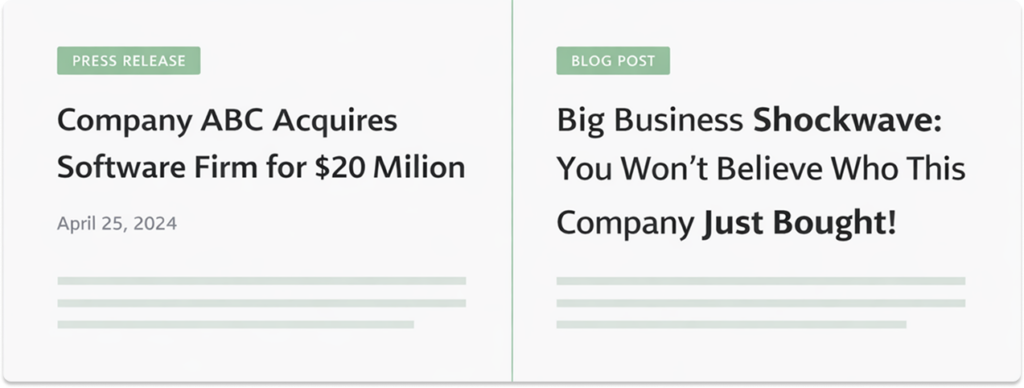
Press release headlines are not blog titles. They do not need to sound chatty. They also do not need to sound dramatic. They need to sound credible.
Comparison between press release headline and blog post title:
When editors look at your headline, they are usually asking three questions:
- What happened?
- Is it relevant to my audience?
- Do I trust this enough to keep reading?
When readers see your headline, they tend to ask a simpler version:
- What is this about, and should I care?
If your headline answers those questions quickly, you get the click, the read, and sometimes the pickup.
If it does not, the release gets ignored, even if the announcement is important. The difference usually comes down to specific qualities.
The Qualities of a Strong Press Release Headline
You do not need a hundred headline tricks. You need a few principles you can apply to almost any announcement:
1. Clear and concise
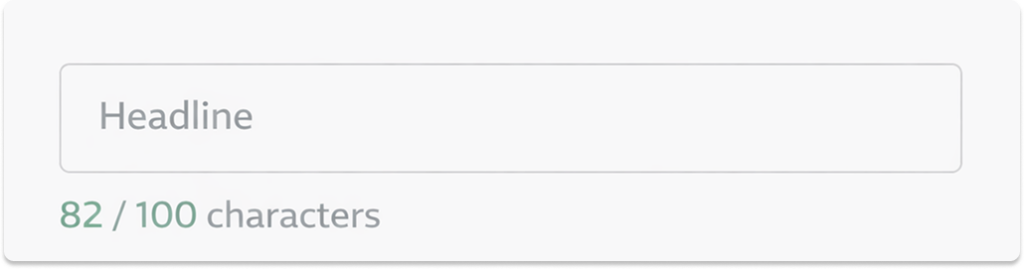
Your headline should be short enough to scan in one breath. As a practical guide, aim for around 80 to 100 characters or no more than 15 words.
Short does not mean vague. It means no extra padding.
A headline that is too long forces the reader to work. Most readers will not.
2. Simple language, not complicated vocabulary
Trying to sound “smart” often backfires.
A headline should be readable by someone who knows nothing about your company. If a reader has to decode your wording, they move on.
Compare these two approaches:
- “There are more trucks on the road, and less-qualified drivers, says local lawyer”
- “Omaha personal injury lawyer alerts drivers about truck crash rates and insurance premium spikes”
Both convey similar meaning, but one is easier to understand immediately. Clarity wins.
3. Reader relevance
Most people do not care about your company update by default. They care about what it means for them.
So instead of framing the headline around your internal achievement, frame it around the impact.
If you are expanding to a new location, mention the location. If you are launching a product, mention the use case. If you are sharing data, mention the insight.
The reader should be able to tell why the headline matters without opening the release.
4. Shareability without hype
A shareable headline usually has one thing: it signals a value or emotion people identify with.
That could be:
- A clear win for customers
- A helpful insight
- A strong public benefit
- A clear milestone that feels impressive
The key is to avoid exaggerated language. You can write something people want to share without sounding like you are trying to force attention.
5. Curiosity with boundaries
Curiosity is useful, but it has limits.
A strong headline can tease a detail that makes the reader want to learn more. But if you hide too much, it becomes vague. If you tease too aggressively, it turns into clickbait.
The safe version of curiosity is this: make the story clear, then leave some details for the body.
6. Benefits over features
Features are not automatically interesting. Outcomes are. For instance:
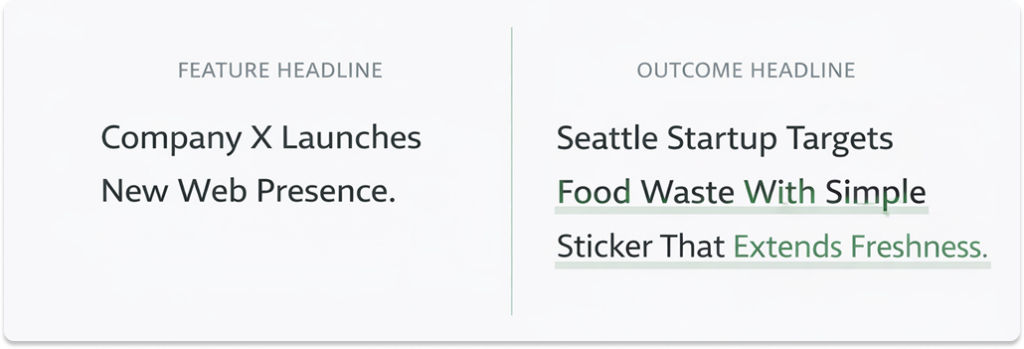
The difference is structural. The first headline tells us what the company did. The second tells us why it matters.
Editors and readers care less about internal milestones and more about impact. A new website is a company update. Reducing food waste is a public outcome. One is operational. The other has relevance.
Benefit-driven headlines answer an unspoken question immediately: Why should I care?
They signal consequences. They show change. They imply value beyond the company itself.
That does not mean every headline needs to sound dramatic. It means the focus should shift from the action taken to the result created.
When a headline communicates outcome, it moves from being an announcement to being a story.
A Practical Headline Writing Process
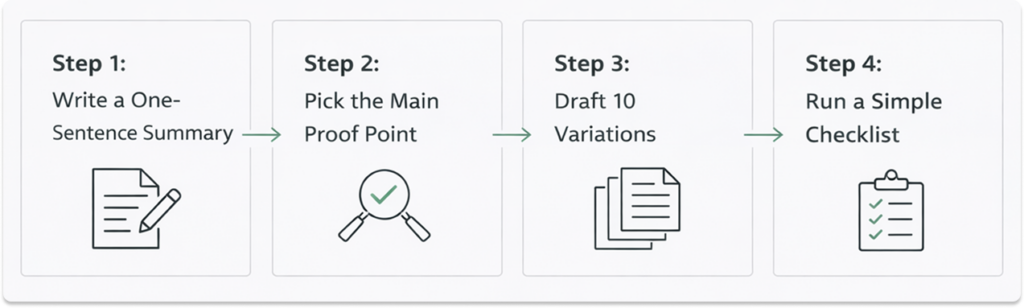
The easiest way to write better headlines is to stop treating the headline as the first step. Instead, treat it as the final step.
Step 1: Write a one-sentence summary of the news
Before you write any headline, write a single sentence that explains:
- Who is involved
- What happened
- Why it matters
This becomes your anchor. It prevents vague headlines because you are forced to clarify the story first.
Step 2: Pick the “main proof point”
Every press release has one detail that makes it worth reading. Identify it.
It could be:
- A number, like 20,000 reviews
- A known brand, like a major partner
- A clear outcome, like faster publishing or safer travel
- A location that adds relevance
Your headline should include this proof point when possible.
Step 3: Draft 10 variations quickly
Do not aim for perfection on draft one. Write 10 options in a row, fast.
You are not trying to “be creative.” You are trying to explore angles:
- Benefit angle
- Data angle
- Local relevance angle
- Partnership angle
- Milestone angle
This gives you choices and prevents you from settling for the first okay idea.
Step 4: Run a simple checklist
Before choosing your headline, check:
- Is it understandable in 3 seconds?
- Does it sound like news, not an ad?
- Would a stranger understand what happened?
- Does it contain a concrete detail when possible?
- Does it match what the press release actually delivers?
If your headline promises something the body does not support, it creates distrust. That is an easy rejection trigger.
Headline Rules That Keep You Out of Trouble
These are the small rules that improve credibility and reduce risk.
a) Use present tense for current news
Press release headlines often use present tense even when the event has already occurred. It keeps the headline immediate and news-like.
Example pattern:

b) Prefer active voice
Active voice is usually shorter and clearer.
- Active: “Company X Launches New Product”
- Passive: “New Product Launched by Company X”
Active voice feels cleaner and more direct.
c) Use numbers only when they are real and defensible
Numbers make headlines stronger because they signal scale.
But numbers also create scrutiny. If you include a figure, be ready to support it inside the press release or with a source.
d) Avoid blog-style phrasing
Press release headlines should not sound like social captions.
Avoid:
- “Guess what happened next…”
- “You won’t believe…”
- “Here’s why everyone is talking about…”
Those styles reduce credibility and make the release feel promotional.
e) Avoid hyperbole and sales language
Terms like “revolutionary,” “groundbreaking,” and “best-in-class” usually weaken a press release headline.
Editors do not want slogans. They want clear news.
f) Write the headline last
A headline written too early tends to misrepresent the story. When you finish the body first, you will naturally see the real main angle and proof point.
g) Use AI as a brainstorming tool, not a replacement
AI can help you generate options or explore angles. The best use is to produce multiple variations quickly, then you choose and refine the best one to match your story.
Examples of Strong Press Release Headlines
Below are examples of headlines that work because they are clear, specific, and anchored in value.
Example 1: Purpose plus local relevance
A headline about launching a mosquito protection initiative with a product launch in Malaysia works because it combines:
- A public benefit people understand
- A concrete product name
- A clear location that adds relevance
It reads like news and gives the reader a reason to care.
Example 2: Partnership with clear geography
A Traveloka and Cebu Pacific partnership headline works because it includes:
- Two recognizable brands
- A clear region and destination
- A direct action, “partners,” that signals what happened
It is informative without being overloaded.
Example 3: Benefit-led product update
A SurgeGraph headline about an auto-optimizer tool works because it leads with the outcome people want, which is speed and efficiency. It also creates a natural curiosity about how the tool works without making exaggerated promises.
Example 4: Milestone with a strong number
A headline celebrating 20,000 Trustpilot reviews works because the number does the heavy lifting. It is easy to grasp, easy to verify, and it signals trust, which is exactly what reviews are about.
Example 5: Curiosity without clickbait
A headline hinting at “Google linking secrets” works because it promises clear value to a specific audience, while still sounding like a legitimate announcement. The “free ebook” element adds a concrete incentive, not a vague tease.
Final Takeaway
Press release headlines are not decoration. They are the entry point.
A strong headline does three things well. It tells the reader what happened, why it matters, and why they should trust it. When those pieces are in place, your press release becomes easier to open, easier to scan, and more likely to be taken seriously by editors.
The simplest way to improve your headlines is to slow down and treat them as a process. Write the body first, identify the main proof point, draft multiple options, and then choose the headline that sounds like clear news.
If you do that consistently, you will not just write better headlines. You will write headlines that make your entire press release perform better.
Frequently Asked Questions (FAQs)
Q: Should a press release headline include the company name?
A: Often yes, but not always. If the brand is known or the company name adds credibility, include it. If the headline becomes too long, prioritize clarity and the main news first.
Q: Is it okay to use a question as a press release headline?
A: It is usually better to avoid questions. Questions can sound like blog content or clickbait. A press release headline generally performs better as a direct statement of news.
Q: Should you include your keyword at the beginning of the headline?
A: If it fits naturally, yes. Early placement helps search engines and helps readers understand the topic faster. But forcing a keyword into an awkward position can reduce clarity, which hurts more than it helps.
Q: Do press release headlines need title case capitalization?
A: Not necessarily. Many press release headlines use sentence-style capitalization. What matters most is consistency and readability. If your brand has a style guide, follow it.
Q: Can a press release headline be different across distribution channels?
A: Yes. You can use a formal version for wire distribution and a shorter variation for email outreach or social sharing. The core claim should remain consistent, but the presentation can be adapted to fit the channel.