

Press Release 101: What to Write, Who Reads It, and Where to Send It
March 12, 2026 at 04:16 PM UTC
 Written by Huey Yee
Most press releases are written correctly and ignored completely.
The format is not the problem. Journalists still rely on press releases: 72% of reporters named them as the most useful resource PR teams can provide, according to Cision’s 2025 State of the Media Report.
The problem is that the majority of releases are written as internal announcements dressed up in AP style. They reach the right inbox and die there.
This post covers the format, the structure, and the strategy behind every element — including the 2026 layer that no “101” guide currently addresses: what happens to your release after a journalist reads it, and whether an AI answer engine decides your brand is worth citing.
What a Press Release Is
A press release is an official announcement written for journalists, not for your customers.
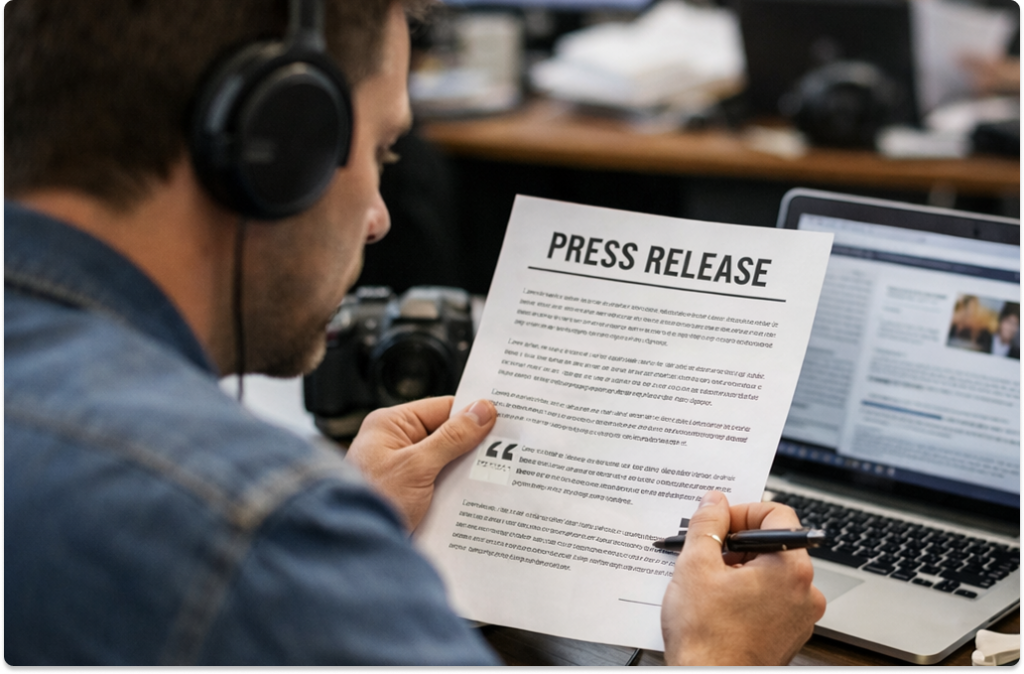
A press release is not a blog post. It is not a product page. It is not a brand story.
It is a structured document that gives a reporter everything they need to file a story without calling you for clarification.
When it works, the journalist lifts your framing, quotes your spokesperson, and publishes something that reaches an audience you could not have reached directly. That is the entire value of the format.
Press Release Format and Structure
Every press release follows the same structural order. Journalists expect it. Deviating from it signals that the sender does not understand how newsrooms work.
The table below maps each element to its function and the standard it needs to meet:
| Element | Purpose | Standard |
|---|---|---|
| Release Status | Signals timing to the journalist | “For Immediate Release” or a dated embargo |
| Headline | The journalist’s first filter | 65–80 characters, newsworthiness first |
| Subheadline | Adds context to the headline | One sentence, key detail the headline omits |
| Dateline | Establishes source location and timing | City, STATE, Date — AP Style |
| Lead Paragraph | Answers the 5 Ws | 50 words maximum |
| Body Paragraphs | Context, supporting data, narrative | 2–3 paragraphs, most important detail first |
| Quote | Ready-to-publish spokesperson voice | 1–2 quotes, conviction over corporate speak |
| Boilerplate | Standard company description | 3–5 sentences, consistent across all releases |
| Contact Information | Journalist follow-up pathway | Name, email, phone — never buried at the end |
This is the skeleton. Every element has a job. Miss one, and you create friction for the journalist trying to use your release.
a) The Headline
Your headline is the only part of your release most journalists will read before deciding to continue.
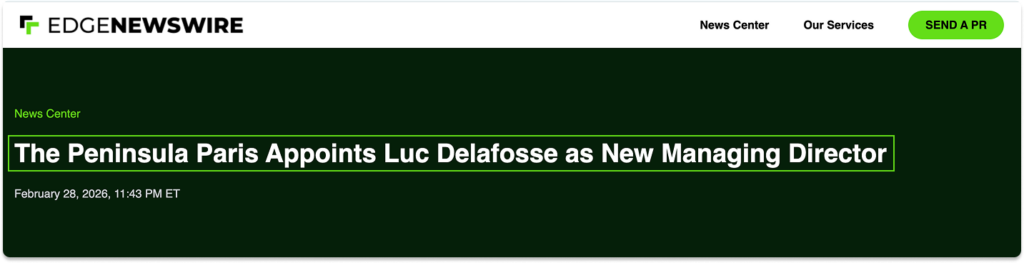
It needs to communicate the news in plain language. Not brand language. Not marketing language. The test is simple: could this headline appear in a newspaper without modification?
If the answer is no, rewrite it. Front-load the subject. Use an active voice. Cut anything that sounds like it belongs in an ad.
b) The Lead Paragraph
In 50 words or fewer, the lead paragraph answers five questions:
- Who
- What
- When
- Where
- Why
This is the inverted pyramid in practice.
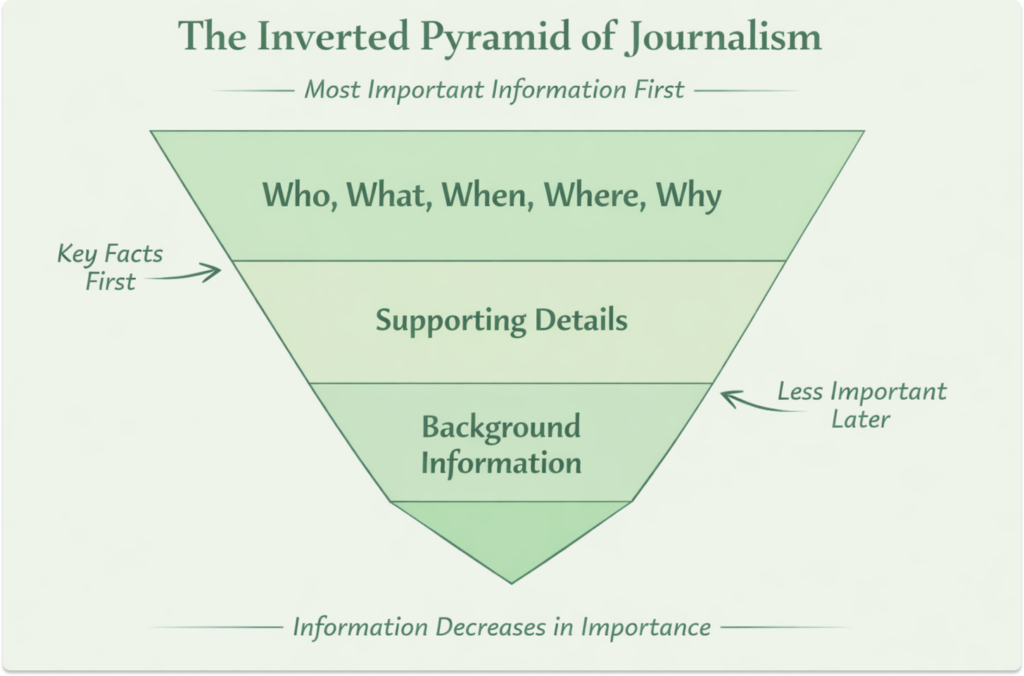
The most critical information sits at the top. Details taper downward in order of importance. The logic is practical: a journalist who needs to cut your release for space will cut from the bottom.
If your most newsworthy fact is in paragraph three, it disappears. Write the lead as if the journalist will read nothing else. Because sometimes, they won’t.
c) Body, Quotes, and Boilerplate
The body paragraphs expand the lead. They add supporting data, relevant context, and the secondary details that give a reporter enough material to write a full story.
Quotes belong here, and they need to earn their place.
A quote that restates what the body paragraph already said is wasted space. A quote should add voice, perspective, or conviction that plain prose cannot carry.
Write quotes the way a real person speaks under pressure — direct, specific, accountable. Journalists use quotes because they add texture to a story. Give them something worth using.
The boilerplate closes the release. It is a standardized paragraph about your organization. Keep it consistent across every release you publish.
This is how AI systems and search engines begin to build an entity understanding of your brand.
d) Contact Information
Include a name, direct email address, and phone number.
This is not optional. Reporters work on deadlines. If your contact information is missing, incomplete, or routes to a general inbox, you have made it easier for a journalist to move on than to follow up.
What Makes a Press Release Newsworthy
Writing a structurally correct press release is not the same as writing a newsworthy one.
Only 10% of the press releases journalists receive are relevant to their beat or audience (Cision, 2025).
That number is the core problem with how most brands approach the format.
They publish announcements — internal milestones dressed up as public news. A new hire, a rebranded logo, a product update that changes three features. These are not news. They are internal events.
News has an external angle. It connects your announcement to something that already matters to the journalist’s audience.
Ask yourself: if your company disappeared from this story, would it still be a story? If the answer is yes, you have found the news angle. If the answer is no, you are writing an advertisement and calling it a press release.
The newsworthiness filters journalists apply before deciding to cover a story:
- Timeliness: Is this happening now, or is it old news with a new press release?
- Relevance: Does this connect to a trend, issue, or topic their audience already follows?
- Impact: How many people does this affect, and how significantly?
- Credibility: Is there data, a third-party source, or an accountable spokesperson attached?
Run your release through all four before you send it.
Press Release Distribution
Writing the release is half the work. Distribution determines whether anyone reads it.
There are three primary channels, and the most effective campaigns use all three in sequence.
1. Direct journalist outreach
This method is the highest-quality channel.
A release sent directly to a reporter who covers your beat — with a one-paragraph pitch explaining why their audience will care — outperforms any mass distribution approach for premium placement.
Nearly 90% of PR professionals prefer direct email outreach for securing meaningful coverage. The tradeoff is time: it requires a targeted media list and personalized pitching at scale.
2. Newswire distribution
This approach provides breadth.
It gets your release in front of a wide network of outlets, financial platforms, and media aggregators simultaneously.
96% of PR professionals use a newswire service at least once within a 12-month period. The value is reach and indexation: newswires push your release to search engines and, increasingly, to the AI systems that pull from indexed news content to generate answers.
3. Owned channel amplification
Your website newsroom, email list, LinkedIn, and X, these channels extend the reach of both approaches and gives your existing audience a direct line to your announcement.
The combination matters.Brands that distribute via wire and amplify across social channels see 2.5x the overall reach compared to wire distribution alone.
If you want a distribution layer built for the way media actually works in 2026 — one that indexes your release for AI discovery, generates a social media kit automatically, and tracks brand authority rather than vanity impressions — EdgeNewswire handles that entire layer from a single submission.
Press Release Mistakes to Avoid
#1 Promotional tone
The moment a journalist reads a superlative, the release reads like an ad. For instance: “industry-leading,” “groundbreaking,” “best-in-class”.
Journalists are trained to distrust promotional language. Write in neutral, factual prose.
#2 Buried lead
If your most newsworthy fact is in paragraph three, the journalist who skims your release will never find it. The news goes in paragraph one. Everything else supports it.
#3 No multimedia
A release without an image, graphic, or video link forces the journalist to source their own visuals. Most will not. Multimedia is not a finishing touch; it is a coverage requirement.
#4 Unfocused distribution
Sending a niche B2B announcement to a mass consumer newswire, or pitching a local story to national business editors, produces silence.
Precision beats volume. Match your distribution to the beat of the journalist and the scope of the story.
#5 No follow-up
25% of press releases that get picked up do so without any follow-up from the sender.
But that means 75% of coverage opportunities are captured through follow-up. Send a brief, direct follow-up email 48–72 hours after distribution. One email. Not three.
Press Releases and AI Discovery
Your press release now has a third audience: AI answer engines.
In 2026, over 40% of Google searches trigger AI Overviews. ChatGPT, Perplexity, and Gemini are generating answers to the exact questions your buyers and journalists are asking — and those answers pull from indexed, structured, credible sources.
If your press release is not optimized for that environment, it is generating a fraction of the value it should.
This is called Generative Engine Optimization (GEO). The CSCE frames the distinction cleanly: “SEO helps a press release be found; GEO helps it be understood and reused.”
How to Optimize a Press Release for AI Discovery
a) Name your entities explicitly
Do not write “the company” or “our platform.” Write your brand name, your product name, your spokesperson’s full name and title.
AI systems build knowledge graphs from named entities. Ambiguous references do not get cited.
b) State facts cleanly
Every data point should have a source attributed in the text.
AI systems favor authoritative, evidence-backed content. A press release with three sourced statistics will consistently outperform one with three unsourced claims.
c) Add multimedia
Releases with multimedia earn up to 9.7x more views than text-only releases.
Video, images, and infographics also create additional discovery points for AI systems scanning content. A text-only release in 2026 is leaving most of its potential reach on the table.
d) Structure for extraction
Subheadings, short paragraphs, and FAQ-style content map directly to how AI systems prompt-match and extract information.
A release written in dense, unbroken paragraphs is harder for a machine to summarize and cite.
A release written in structured sections with clear claims is ready to be surfaced in an AI-generated answer without modification.
The brands that understand this layer in 2026 will build compounding authority in AI-generated answers. Those that ignore it will find their releases generating less and less return as AI search absorbs a larger share of media consumption.
Final Takeaway
You now have the format, the newsworthiness framework, and the 2026 AI layer. The last variable is where you send it.
EdgeNewswire distributes your release across 2,000+ media endpoints, automatically generates a social media kit from your announcement, and tracks your brand’s presence in search snippets and AI-generated answers — not just impressions. Submit your first release here.
Frequently Asked Questions (FAQs)
Q: What is a press release used for?
A: A press release is an official announcement sent to journalists and media outlets to generate news coverage. Common uses include product launches, funding announcements, executive appointments, partnerships, events, and company milestones. The goal is earned media — coverage in publications your brand does not own or pay for.
Q: How long should a press release be?
A: A press release should be between 400 and 600 words. Journalists do not read long documents under deadline pressure. Every word should serve the story. If you need more than 600 words to explain the announcement, the announcement is not focused enough.
Q: How do I get my press release picked up by journalists?
A: Target journalists who already cover your beat, lead with the external news angle rather than the internal announcement, include at least one sourced statistic, provide a usable quote, and attach a high-resolution image. Follow up once, 48–72 hours after sending, with a single direct email.
Q: Do press releases still work in 2026?
A: Yes. 72% of journalists named press releases as the most useful resource PR teams can provide (Cision, 2025). 83% of journalists use them as a primary story source (Medianet, 2025). The format works. What does not work is a press release written as an advertisement, sent to the wrong journalists, with no multimedia and no follow-up.
Q: What is the difference between a press release and a media pitch?
A: A press release is a formal, structured document containing the full details of an announcement. A media pitch is a short, personalized email to a specific journalist explaining why the story is relevant to their audience. The most effective PR outreach pairs both: the pitch gets the journalist’s attention, the press release gives them everything they need to write the story.