

News Center
Featured News
Recent News

October 20, 2026
Beeline Holdings (NASDAQ: BLNE) Targets $3M in Additional Annualized Operating Expense Reductions

October 20, 2026
Greenland Mines (NASDAQ: GRML) (FSE: HK6) Begins Trading on Xetra to Expand Global Investor Access

October 20, 2026
Sovico and Hamburg Forge Partnership to Expand Vietnam-Germany Economic Ties

October 16, 2026
Mobilicom (NASDAQ: MOB) Is ‘One to Watch’
October 15, 2026
Greenland Mines (NASDAQ: GRML) (FSE: HK6) Welcomes Trump Comments on Greenland Mineral Exploration and Strategic Importance

October 15, 2026
TruGolf Holdings (NASDAQ: TRUG) Taps Newly Acquired Polymath to Tokenize Franchise Ownership Records

October 15, 2026
Green SM Officially Launches All-Electric Taxi Service in the U.S.
October 14, 2026
SS Innovations International (NASDAQ: SSII) Submits FDA Response for SSi Mantra Surgical Robotic System

October 13, 2026
VERAXA Biotech (NASDAQ: VRXA) Presents First In Vivo Proof-of-Concept Data for BiTAC-ADC Platform at World ADC Congress

October 13, 2026
OPPO Unveils ColorOS 17 Globally: Silky Smooth. Flow with AI

October 12, 2026
Geely Auto Group Makes Its Paris Motor Show Debut with Geely Auto, Lynk & Co and Zeekr

October 12, 2026
Mobilicom (NASDAQ: MOB) Launches SwarmiX Secure Mesh Communications Solutions for Drone and Robotic Fleets

October 12, 2026
Greenland Mines (NASDAQ: GRML) Welcomes EU Strategic Project Designation for Neo Performance Materials Silmet 2.0

October 11, 2026
Geely Auto Group Mainstream Brand Officially Announces Entry into the Canadian Market.

October 9, 2026
OPPO Find X10 Pro Max to Debut Globally with MediaTek’s 2nm Flagship Dimensity 9600 Pro

October 9, 2026
TruGolf Holdings (NASDAQ: TRUG) Completes Acquisition of Polymath Research, Expanding into Institutional Asset Tokenization
More News
October 3, 2026
Huawei Highlights Continuous Innovation, Securing Competitive Edge Through Technological Breakthroughs
SHENZHEN, CHINA – Media OutReach Newswire – 3 October 2026 – Huawei hosted an international media roundtable today featuring Richard Yu, Executive Director, Chairman of the Investment Review Board, and Chairman of the Board of Directors of the Consumer BG. Yu shared comprehensive insights into Huawei's consumer business and HarmonyOS ecosystem. Richard Yu joined Huawei in 1993, working on early developments like the first-generation program-controlled switch and participating in the establishment of Huawei's wireless communications business, which started with GSM. Over the past decade, Yu has led Huawei's consumer business with the vision to deliver a seamless AI life experience to all consumers across five key scenarios: HIMA-powered Smart Travel, HarmonyOS Office, Smart Home, Fitness & Health, and Entertainment, which he said is also the long-term strategy for Huawei's consumer business over the next 10 years. Between 2007 and 2025, Huawei invested more than CNY1.8 trillion into R&D shifting from roughly 10% of annual revenue in early years to over 20% recently. Huawei has continued to increase investment into the core technologies of the ICT domain and basic research, which has translated into robust core capabilities, extensive intellectual property, and a vast patent portfolio, and helped with achieving a series of breakthroughs in technological innovation. The Mate 90 series smartphones Huawei just launched come with the latest Kirin 9050 Pro chip. The overall device performance is 31% higher than the previous generation. The Balong modem, image sensor processor (ISP), mobile security processor (MSP), Lingxi CPU, Maleoon GPU, and the NPU that adopts Huawei's Da Vinci architecture for AI processing are all designed by Huawei. They offer higher energy efficiency and deliver much-improved overall system-level performance. Even though Yu admitted that Huawei has limited access to advanced semiconductor processes, Huawei recently made a new breakthrough in the semiconductor domain - the LogicFolding technology under the Tau Scaling Law. Unveiled by He Tingbo, head of Huawei's Semiconductor Business Department this May, this technology vertically stacks the logic layers of chips and restructures the circuit layout through inter-layer high-density interconnect to shorten critical paths and reduce latency. This technology was adopted on Kirin 9050 Pro chip, which shows very strong AI processing power. The Mate 90 series powered by this chip can run a 30B MoE on-device AI model. In the AI domain, Yu talked about the Ascend compute foundation that Huawei provides, by remarking Huawei's large models called openPangu, AI capabilities for intelligent driving, and HarmonyOS Celia, which is similar to Gemini in the Google Android ecosystem. Huawei is also using AI to improve the O&M of communications network equipment. By combining AI computing power with domestic open-source large models, Huawei's vision is to help enterprises and industries around the world to become more productive and bringing more convenience to everyone. In the past years, Huawei has launched a broad series of products and solutions, including smartphones, PCs, tablets, wearables, TWS audio products, Smart TVs, home routers, smart home control solutions, as well as intelligent electric vehicles together with partners. Underlying these products and solutions are Huawei's chip hardware platform and HarmonyOS - another OS ecosystem after iOS from Apple and Android from Google that Huawei developed to support all the smart devices and smart hardware across all scenarios. Development of HarmonyOS began in 2019. Before that, Huawei was a major contributor to the Android community as well as the entire Android ecosystem. Now, more than 90 million devices, including smartphones, PCs, and tablets, currently run on HarmonyOS 6 and HarmonyOS 7. This figure is expected to hit the 100 million mark by the end of this year. The number of apps and services in the HarmonyOS ecosystem has already exceeded 450,000. Its global registered developer count has reached 11 million, and Huawei now has over 23,000 app innovation partners. Expressing his special thanks to all partners and developers for their trust and support, Yu also pointed out that Huawei is considering gradually bringing HarmonyOS to the global market in the future. Globalization is another topic of the conversation. Yu mentioned that Huawei had very good collaboration with many companies from the US, Europe, Japan, South Korea, and Taiwan, delivering huge business value and benefits to those partners. When it comes to the difficulties that Huawei overcame since 2019, Yu said that relying on homegrown technologies and capabilities, Huawei gradually designed its own operating system and developed basic tools and software by themselves, putting a domestic supply chain in place. In 2023, Huawei started to manufacture the chips used by smartphones domestically again. With these chips and HarmonyOS, and by relying on China's domestic supply chain, materials, and process nodes, Huawei has basically gotten rid of the dependence on US technologies. While Huawei's global market share was once No. 1, nowadays it only sells several million units of smartphones outside China every year. However, Yu revealed that Huawei is trying to return to the overseas market step by step. Taking wearables as an example, Huawei is No. 1 in terms of the market share both in China and globally. Other innovative products such as TWS earphones, are also growing fast and have reached No. 1 in many countries. While Huawei's tablet and PC business was greatly affected after it was denied access to Windows and Intel x86 chips, the HarmonyOS-based tablets are now performing strongly. Another example would be CPE, which is a mobile router that provides connectivity to the unconnected in remote and rural areas. These products are also very well received across many regions outside China, helping more people connect to the rest of the world and live better lives. Question: Both the Huawei XT 2 and the two most advanced models of the Mate 90 series use a LogicFolding chip. Will LogicFolding chips be used for more phones in the future? We understand that Huawei's chip production capacity is still limited. Huawei has launched SuperPoDs, and AI infrastructure is a huge business. They are both very important in China. How do you secure a larger share of the chip supply internally? Richard Yu: We started introducing the chip that adopts the LogicFolding technology powered by the Tau Scaling Law to the Mate XT 2 tri-fold phone. To answer your question, yes, more of our phones will definitely use these LogicFolding chips in the future. Currently, the production capacity for advanced semiconductors in China still cannot meet the rapidly growing demand. Huawei's Ascend chips for the AI domain also use such capacity. But we have developed a requirement plan, which also covers the chip requirements of smartphones. The sharp price increase for memory components over the past two years has somewhat limited the smartphone sales volume. Even though the production capacity remains tight right now, generally it is sufficient to meet our market shipment needs. We hope that production capacity will ramp up in China's semiconductor industry so that we can manufacture more advanced products for consumers in the Chinese market as well as the overseas market in the future. To read the full Q&A session: https://www.apmultimedianewsroom.com/multimedia-newsroom/continuous-innovation-securing-our-competitive-edge-through-technological-breakthroughs Hashtag: #HuaweiThe issuer is solely responsible for the content of this announcement.

October 2, 2026
Beeline Holdings (NASDAQ: BLNE) Offers $3,000 Credit to Expand Bank Statement Mortgage Business
Beeline Holdings (NASDAQ: BLNE), an expanding digital mortgage platform offering a quicker and easier path to homeownership, has now introduced a $3,000 lender credit for qualifying Bank Statement mortgages, seeking to expand a business line aimed at self-employed borrowers as the company reports continued momentum in its shift toward higher-margin Non-Qualified Mortgage products. Announced September […]

October 1, 2026
TruGolf Holdings (NASDAQ: TRUG) Announces First TruGolf Range Installation Featuring AI Coach
TruGolf (NASDAQ: TRUG) announced the first installation of its indoor range platform, TruGolf Range, featuring the company’s new TruGolf AI Coach experience at Lucid Golf in New Albany, Indiana. TruGolf Range allows up to five players to practice simultaneously on a single cinematic screen, with each hitting bay providing slow-motion replay of club and ball […]
October 1, 2026
Huawei Launches the HUAWEI Mate 90 Series, Equipped with the Flagship Tau Chipset Across the Entire Series
SHANGHAI, CHINA – Media OutReach Newswire – 1 October 2026 – Huawei today officially launched its next-generation flagship HUAWEI Mate 90 Series, featuring the powerful LogicFolding Tau Chip, the Kirin 9050 Pro. Packed with breakthrough innovations, including the XMAGE True-to-Color Portrait Camera, the Second-generation Linglong Display, full-body Kunlun Xuanwu architecture, and the HUAWEI XMAGE Z10 Modular Camera, the series sets a new benchmark for mobile technology. Richard Yu, Executive Director of Huawei, Director of the Investment Review Board, and Chairman of the Huawei Consumer BG, stated: "The HUAWEI Mate 90 Series is equipped with the flagship Tau chipset across the entire series. Through vertical integration of hardware, software, chips, and cloud, we have achieved a comprehensive evolution in design, performance, imaging, reliability, and smart user experience. Today, we step into a new era of brilliance." Between 2007 and the end of 2025, Huawei invested a total of CNY1.8 trillion into R&D. Today's product breakthroughs are the direct result of long-term R&D investment and a foundation of core technology. Huawei is turning foundational advancements in Kirin, HarmonyOS, and beyond into tangible product experiences that consumers can truly feel. Meticulously Crafted, Radiant at First Sight The HUAWEI Mate 90 Series introduces a refined, seamless design, pairing a glossy mid-frame with a matte metal rear cover. In terms of durability, the Mate 90 Pro and higher models are built on the full-body Kunlun Xuanwu architecture. The camera cover introduces the industry's first Optical Kunlun Glass, delivering 20x better drop resistance, while the front display is protected by 3rd-gen Kunlun Glass, offering a 50% improvement in impact resistance. The Pro Max Premium Edition and RS ULTIMATE DESIGN go further with upgraded Xuanwu Kunlun Glass, cutting reflections by 70% and boosting scratch resistance by 16x. The entire lineup supports IP68 dust and water resistance up to 6 meters alongside IP69 resistance against high-temperature, high-pressure water jets. Powered by LogicFolding Tau Chip: A Massive Leap in Performance At the heart of the HUAWEI Mate 90 Pro Max is the LogicFolding Tau Chip, built on an innovative architecture that drastically compresses critical path latency to enable 5 million signal transmission bonds and an impressive 125 TB/s inter-die bandwidth. The Pro Max Premium Edition and RS ULTIMATE DESIGN are powered by the Kirin 9050 Pro chip, delivering a 31% increase in overall performance. Meanwhile, the Pro model's Kirin 9035 chip brings a 20% performance boost, and the standard edition's Kirin 9030 chip offers a 27% gain in performance. Vertically integrated with HarmonyOS 7 across hardware, software, chips, and the cloud, the Kirin 9050 Pro CPU supports hyper-threading technology for effortless, ultra-smooth operations. Mobile gaming also reaches new heights with hardware-accelerated ray tracing, capable of rendering up to 55 million rays per second. Second-Generation Linglong Display: A Screen That Truly Stands Out The HUAWEI Mate 90 Pro introduces the second-generation Linglong Display, reaching an unprecedented peak brightness of 12,000 nits at 1% APL. Built on an enhanced Tandem OLED Architecture, panel lifespan is extended by 138%. The HUAWEI Mate 90 Pro Max and RS ULTIMATE DESIGN debut the Full-color Linglong Display. Leveraging its 12,000-nit ultra-high brightness and full BT.2020 end-to-end color management, over 60 mainstream apps can now upsample P3 content to vibrant, full-color BT.2020 quality. Eye care technology also receives a major upgrade, featuring industry-first ambient light detection and a 1-nit ultra-low brightness eye-comfort mode for a seamless, strain-free viewing experience. Breakthrough Connectivity & Reliable Outdoor Utility Connectivity gets a total overhaul. The industry-first Wi-Fi and cellular converged antenna architecture boosts signal gain by 2 dB. The entire lineup supports eSIM, with the Pro Max pioneering four-SIM, three-standby functionality. With multi-device communication sharing, photo and video upload speeds are boosted by up to 40% in congested environments like crowded concerts or remote outdoor areas. XMAGE True-to-Color Portrait The entire series comes equipped with True-to-Color Camera 3.0, featuring full-focal-length infrared optical coating for the first time, which advances overall color accuracy by 37% and skin-tone accuracy by 62%. The updated XMAGE True-to-Color Portrait engine introduces four versatile shooting modes: Portrait original, Soft light portrait, Dazzling fireworks, and Starburst, delivering striking, authentic portraits that speak directly to the heart. The Pro Max features a powerful 18 EV ultra-HDR main camera, a large-sensor 200 MP RYYB telephoto camera, and CIPA 7.5-rated hardware image stabilization, guaranteeing crisp, steady shots even beyond 20x zoom. The lineup also introduces a dedicated live-streaming optimization mode, making it an ideal companion for content creators. Additionally, the HUAWEI XMAGE Z10 Modular Camera features a 1-inch large sensor, 24–240 mm continuous optical zoom, and a maximum aperture of f/2.0 to f/4.5, providing pristine, studio-quality imagery across every focal length. HarmonyOS AI: Smarter, Proactive, and Seamless Powered by the 30B MoE full-modal on-device foundation model on the Pro Max and higher models, next-generation AI features come to life. Celia Memories seamlessly syncs and organizes content from over 50 mainstream apps, while the Celia navigation bar proactively suggests over 30 context-aware actions based on on-screen content. For everyday tasks, Celia Call 2.0 handles automated call answering, call summaries, and real-time translation, while the Celia Gallery Assistant enables intuitive voice- or text-driven photo editing and instant video generation. Furthermore, HarmonyOS Interconnect brings distance-free remote Huawei Share and allows one-tap sharing to multiple HarmonyOS devices simultaneously. Committed to taking the harder but right path, Huawei provides users and developers with a powerful alternative in HarmonyOS. Today, HarmonyOS 6 and HarmonyOS 7 power over 90 million devices, including smartphones, PCs, and tablets, and are on track to pass the 100 million mark by the end of this year. At the same time, Huawei's global registered developer community has grown to over 11 million. ULTIMATE DESIGN: See the Extraordinary The HUAWEI Mate 90 RS ULTIMATE DESIGN evolves the iconic Star Diamond camera module aesthetic and debuts Dynamic Lenticular Kunlun Glass, elevating high-durability materials into an expression of premium design. The rear cover showcases an all-new Ascending Texture available in Red, White, and Black. Under the hood, it packs the Kirin 9050 Pro chip, Full-color Linglong Display, Tiantong Satellite Communications, BeiDou Satellite Messaging, four-SIM three-standby, and the advanced True-to-Color Camera 3.0 with an 18 EV ultra-HDR main camera, delivering ultimate design, technology, imaging, and experience. The series starts at CNY5,999 for the HUAWEI Mate 90, CNY6,999 for the HUAWEI Mate 90 Pro, CNY9,499 for the HUAWEI Mate 90 Pro Max, and CNY12,999 for the HUAWEI Mate 90 RS ULTIMATE DESIGN. Hashtag: #HuaweiThe issuer is solely responsible for the content of this announcement.

September 30, 2026
Huawei Pioneers a New Computing Architecture for the AI Era: Making One Million Processors Work as One Computer — Summary of Roundtable Meeting Between Eric Xu and International Media Outlets on September 17
SHANGHAI, CHINA – Media OutReach Newswire – 30 September 2026 – During HUAWEI CONNECT on September 17, 2026, Eric Xu (Huawei's Rotating Chairman) and Dr. Liao Heng (Chief Scientist of HiSilicon) had a Q&A session with journalists of media outlets to discuss Huawei's Peerium Computing Architecture for the AI era as well as UnifiedBus (UB). At last year's HUAWEI CONNECT, Eric Xu gave a keynote speech and released Ascend chips and their roadmap (including the 950, 960, 970, and SuperPoDs and SuperClusters). He also announced the open release of the UnifiedBus protocol. At this year's HUAWEI CONNECT, Huawei announced the Ascend 950 and the Atlas 950 SuperPoD. While the industry is talking about SuperPoDs or supernodes, the ways of making these products differ hugely. The key of SuperPoDs is about allowing several thousand or even tens of thousands of processors to work as one computer. Today, Huawei announced a SuperPoD based on the Ascend 950 chip. The SuperPoD is powered by a new computing architecture that Huawei has pioneered. This architecture now can make one million processors work as one computer. This architecture is called Peerium, and it can achieve strong scaling to the million-processor level through nested parallelism, unified memory addressing, and peer-to-peer interconnect. It extends the parallelism paradigm of Turing with the introduction of Nested BSP (Nested Bulk Synchronous Parallel). This architecture also extends the von Neumann single-machine architecture and overruns the master-slave design paradigm that has prevailed for decades. Given that the available technologies in the industry could not support this architecture, Huawei invented a key interconnect technology – UnifiedBus. Ultimately, one million processors can truly work as one larger computer. UnifiedBus is a high-speed bus that uses an open protocol to scale without a limit to connect CPUs, NPUs, memory, SSDs, interface cards, and switches. With UnifiedBus, peer-to-peer interconnect is achieved across compute, storage, and networking. This fundamentally overruns the traditional master-slave architecture. The Atlas 950 SuperPoD is a product built upon the Peerium Computing Architecture. A SuperCluster with 256,000 computing cards is currently being deployed and tested. Q: Dr. Liao, your paper mentioned a SuperPoD that's made up of 256,000 cards. Is that the upper limit of your technology? Can you tell us more about market demand for your products? Liao Heng: 256,000 or roughly 200k, this number is not an arbitrary number. First of all, the purpose of these large clusters is for training. It has a hardware infrastructure that can support the training of foundation models, which today are already in the 5T parameter range. Over the next two years, there will be roughly 6 or 7 frontier AI labs in China, and all will aim at training foundation language models of sizes ranging from 10 to 40 trillion parameters. These numbers kind of match up to the memory capacity and the size of the SuperPoD. So you need such a scale of infrastructure to train these models. The second thing is that in China, most data centers have a national plan on this power grid. So 200,000 is a relatively conservative number, given the design of the power delivery system in a single autonomous zone and single data center campus. As I said, everybody must be quite familiar with the AI model race that's happening across the globe. And in China, there are at least 3 or 4 tier-1 players that are already well recognized and have achieved tier-1 status. Q: What are your plans to encourage Chinese model providers to use Ascend chips for training? Eric Xu: For the Ascend 950, we first launched the 950PR to the market. It's primarily used for AI inference, and currently the total volume of supply available in the market is not very big. The SuperPoDs based upon the Ascend 950DT are mainly used for AI training. Right now, they are under testing, and their large-scale supply will start at the end of this year or early next year. We are having extensive dialogues and discussions with AI model providers. The testing result of using the Ascend 950DT for training is pretty good. I believe that starting from next year, a lot of AI model training will be based upon SuperPoDs that use the Ascend 950DT. I think at the end of the day, it's not about how hard we are going to push model providers, but about how much supply capacity we will have. We can only supply based on how much that's produced. And we hope the value chain will expand its capacity faster to increase supply. Q: What is Huawei's take on recent calls by leading AI model providers in the US to slow down AI development? Eric Xu: We need to look at the level and cadence of AI development in China and the US. AI models in China are largely open-source models and their progress is relatively transparent. If we look at the mainstream model providers in the US, they have more computing power, so maybe only they themselves know where they are in terms of the level of sophistication of their models. The market feeling about AI risks might be weaker in China than in the US. Model providers in China need to speed up their pace to reach a level where they could also feel the risks from AI development. And then, maybe they will feel the same as the leading US model providers. But I always believe that we need to strike a balance between driving AI development and managing AI risks. At the very least, the bottom line is we need to ensure AI for good, not AI for evil. Q: Does Huawei have plans to bring the Atlas 950 SuperPoD to other markets outside China? If yes, which markets are you going to target? Can you share with us data about your market share in China? What is your take on China's push for chip self-sufficiency? Eric Xu: Since we don't have enough capacity to even satisfy the demand in China, we don't have plans to expand to the international market in a fully-fledged way. But indeed, there are several countries that have very strong demand. We are doing some testing, and we are providing some supply to those countries, but the volume is quite limited. Right now, it's pretty hard to collect data about the market share of NVIDIA in China. But based on the data we have collected, Ascend has surpassed NVIDIA. China's push for chip self-sufficiency is an inevitable path forward. China is a country of 1.4 billion people and it's an industrial powerhouse, so the way people work and live is closely tied to chips. Chinese people have a keen sense of urgency, and will not accept a future in which others decide whether or not we can have access to certain products. Even though our chips may be less advanced, at least their supply is assured, so that you don't have to worry about chip supply day in and day out. I think that's certainly the path forward. For the Chinese government, for the domestic industry, and for Huawei, the path forward is undoubtedly to push for full self-sufficiency in terms of chips and the entire semiconductor value chain. We also believe this will become a reality sooner or later. To read the full Q&A session: https://www.apmultimedianewsroom.com/multimedia-newsroom/huawei-pioneers-a-new-computing-architecture-for-the-ai-era-making-one-million-processors-work-as-one-computer-2 Hashtag: #HuaweiThe issuer is solely responsible for the content of this announcement.

September 29, 2026
Greenland Mines (NASDAQ: GRML) (FSE: HK6) Raises Over $17 Million, Adds Two Directors
Greenland Mines (NASDAQ: GRML) (FSE: HK6) announced that it raised over $17 million through a registered direct offering of common stock at $13 per share, bringing its total capital raised over the past week to more than $59 million. The company said the financing strengthens its balance sheet and provides capital for planned exploration and […]
September 29, 2026
CATL Partners with BME to Advance Battery Pack Manufacturing in Egypt Through Technology Licensing

September 29, 2026
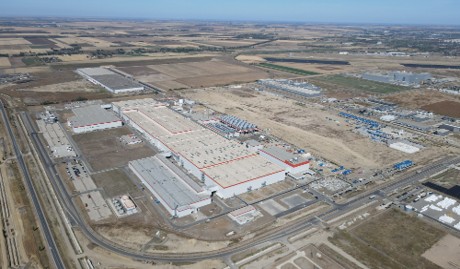
CATL Debrecen Kicks Off Trial Operations in its New Cell Building
September 29, 2026
Lunit Expands AI-Powered Breast Cancer Screening Across the Stockholm Region
Following years of clinical validation and proven real-world performance at Saint Göran, Stockholm Region adopts Lunit INSIGHT MMG as an independent second reader at regional scale.

September 28, 2026
Azio AI Holdings (NASDAQ: AZIO) Unveils Flagship Atlas One Project to Tackle AI’s Power Shortage
Building an AI data center is no longer just about buying enough graphical processing units (“GPUs”); rather, it is about finding enough electricity to run them. Azio AI Holdings (NASDAQ: AZIO) is committed to addressing that challenge, and just announced its Atlas One project, a South Texas compute campus designed around power the company generates […]