




--Addressing climate change by encouraging decarbonization efforts through SAF use--
August 16, 2024 -- Nippon Express Co., Ltd. (President: Shinjiro Takezoe; hereinafter, "Nippon Express"), a group company of NIPPON EXPRESS HOLDINGS, INC. (President: Satoshi Horikiri), was selected on Thursday, August 5 as a designated cargo agent for the "Project to Promote SAF Use in Air Cargo Transport for Corporate Compliance with Scope 3 Requirements(*1)"(*2), a Tokyo Metropolitan Government-subsidized project.
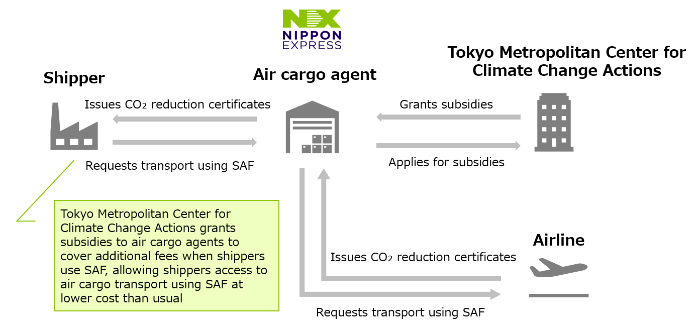
The "Project to Promote SAF Use in Air Cargo Transport for Corporate Compliance with Scope 3 Requirements" seeks to reduce CO2 emissions across companies' entire supply chains. The subsidies it grants cover the additional cost of using SAF for air cargo transport through designated cargo agents until the end of March 2025.
The NX Group has positioned expanded SAF use as one of its initiatives to "develop and strengthen sustainable solutions," a material issue for the Group, and it has been providing customers with the "NX-GREEN SAF Program" as well as participating in the "SAF Flight Initiative" offered by ANA. In recognition of such efforts to encourage wider use of SAF, Nippon Express has been selected as a designated cargo agent for this project.
Questions around this news
What is sustainable aviation fuel (SAF)?
SAF is aviation fuel made from alternatives to conventional fossil-based jet fuel, such as certain renewable or waste-derived materials. It can be used in aircraft engines and fuel systems designed for compatible fuels. Its potential climate benefit depends on how it is produced and the emissions across its full life cycle.
What costs does the Tokyo Metropolitan Government project subsidize?
The project supports the use of SAF in air cargo transport by subsidizing the additional cost associated with using it through designated cargo agents. The release says the subsidy program is set to run until the end of March 2025. Nippon Express was selected as one of the agents for the project.
What climate targets has the NX Group announced?
The NX Group says it aims to cut its group-wide Scope 1 and Scope 2 emissions by 50% from 2013 levels by 2030. It also states a goal of helping achieve carbon-neutral societies by 2050, covering Scope 1, Scope 2 and Scope 3 emissions. The group submitted a commitment letter to the Science Based Targets initiative in May 2023.
What does Scope 3 mean in emissions reporting?
Scope 3 covers indirect greenhouse gas emissions connected to an organization’s activities that are not included in its direct emissions or the emissions from purchased energy. Examples can include emissions from suppliers, product transport, employee commuting and business travel. The categories included depend on the organization’s value chain and reporting boundary.
In tackling climate change, the NX Group aims to reduce in-house emissions Group-wide (SCOPE 1, 2) by 50% from 2013 levels by 2030, and in May 2023 submitted a letter of commitment to obtain certification under the Science Based Targets initiative (SBTi). Its goal is to help bring about carbon-neutral societies by 2050 (SCOPE 1, 2, 3). Going forward, the Group will continue sharing its stances on environmental conservation with its stakeholders and pursue efforts focused on material issues to achieve the NX Group Sustainability Vision.
[Related releases]
■Nippon Express participating in ANA's new program "SAF Flight Initiative: For the Next Generation"
https://www.nipponexpress-holdings.com/en/press/2021/21-Oct-21-1.html
■NX Group begins offering "NX-GREEN SAF Program" in Japan
https://www.nipponexpress-holdings.com/en/press/2024/10-Apr-24-1.html
(*1) The GHG Protocol, an international standard jointly developed by the World Resources Institute (WRI) and the World Business Council for Sustainable Development (WBCSD), classifies a company's CO2 emissions into three categories:
Scope 1: Direct CO2 emissions from the company's business activities
Scope 2: The company's CO2 emissions from electricity consumption and other heat/power sources, etc., supplied by other companies
Scope 3: Indirect CO2 emissions from the company's business activities (transport of products, employee commuting, business trips, etc.)
(*2) Tokyo Metropolitan Government "Cool Net Tokyo" website: https://www.tokyo-co2down.jp/subsidy/scope3
If you detect any issues, problems, or errors in this press release content, kindly contact [email protected] to notify us (it is important to note that this email is the authorized channel for such matters, sending multiple emails to multiple addresses does not necessarily help expedite your request). We will respond and rectify the situation in the next 8 hours.
At a glance
- Company
- Nippon Express Co., Ltd.
Key figures
- Scope 1 and 2 emissions reduction target
- 50% from 2013 levels by 2030
- Project subsidy period
- until the end of March 2025
- Carbon-neutral society goal
- by 2050
People
- Shinjiro TakezoePresident of Nippon Express Co., Ltd.
- Satoshi HorikiriPresident of NIPPON EXPRESS HOLDINGS, INC.
