




August 21, 2026 -- Mitsui & Co., Ltd. ("Mitsui", Head Office: Tokyo, President and CEO: Kenichi Hori) and the renewable energy company European Energy A/S ("EE", Head Office: Søborg, Denmark) are working to expand the customer base and applications for the world's first e-methanol. The e-methanol is produced at a plant that was established by Solar Park Kasso ApS, a subsidiary of a joint venture between Mitsui and EE, and is located in Kassø, Aabenraa Municipality, in southern Denmark.
The initial shipment of e-methanol produced under this project was supplied to Danish shipping giant A.P. Moller - Maersk in May 2025 for use as marine fuel. In the spring of 2026, the project also began to supply e-methanol for use in chemical products to the LEGO group, a leading toy manufacturer, and Novo Nordisk, a global healthcare company. The customer base continues to expand, which includes decisions to supply e-methanol as a Renewable Fuel of Non-Biological Origin (RFNBO) to leading European energy firm OMV for use as a land-based transportation fuel.
In brief
Mitsui & Co. and European Energy are seeking to broaden the buyers and uses for e-methanol made at the Solar Park Kasso facility in southern Denmark. The project’s first shipment went to A.P. Moller - Maersk in May 2025 for marine fuel. In spring 2026, supplies also began for chemical products used by the LEGO group and Novo Nordisk. The companies report a decision to supply OMV with e-methanol certified as a Renewable Fuel of Non-Biological Origin for land transport. Mitsui says the project aligns with its strategy to grow low-carbon energy offerings and support energy transformation. The release describes e-methanol as a product made with renewable electricity-derived hydrogen and biomass-based carbon dioxide.
Key takeaways
- The Kasso facility’s e-methanol has been supplied for marine fuel and chemical-product applications.
- The LEGO group and Novo Nordisk began receiving e-methanol in spring 2026, according to the release.
- A planned supply to OMV is for RFNBO use as land transportation fuel.
- Mitsui says e-methanol’s compatibility with existing methanol infrastructure can support additional transport uses.
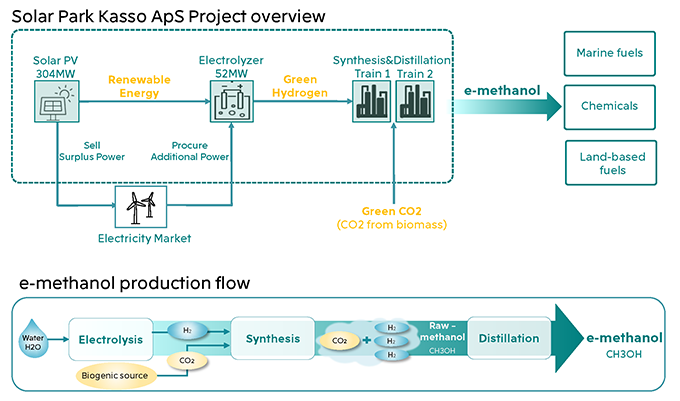
Mitsui has designated "Global Energy Transformation 2.0" as one of its key strategic initiatives in Medium-term Management Plan 2029, with the aim of expanding the range of low-carbon energy products while building an optimized value chain in line with the external environment and customer needs, both of which are changing rapidly. e-methanol is a low-carbon methanol produced by synthesizing green hydrogen generated using renewable energy-derived electricity with green carbon dioxide (CO2) derived from biomass. A key advantage of e-methanol is its high compatibility with existing infrastructure, such as methanol distribution networks and storage facilities. This allows it to contribute to decarbonization as a synthetic fuel for the transportation sector, including applications for which it has proved difficult to use green hydrogen alone, such as fuel for land transport and aviation. Demand is expected to expand across Europe, especially Germany, driven by policy frameworks such as the Renewable Energy Directive (RED III). By strengthening its supply capacity for low-carbon methanol, Mitsui will contribute to both the realization of energy transformation and the achievement of a sustainable society.
Solar Park Kasso overview and e-methanol production flow
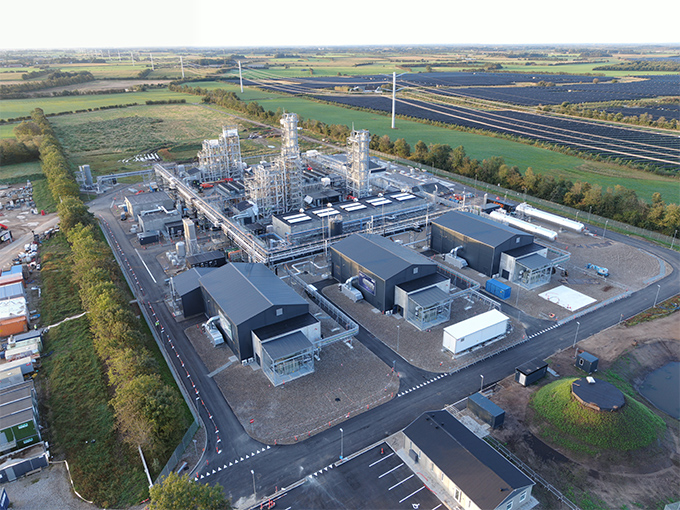
PtX plant Solar Park Kasso
Mitsui’s Materiality
“Build brighter futures, everywhere” as our corporate mission, and to gain the trust and expectations of our stakeholders to realize a better tomorrow for earth and for people around the world, we have identified six material issues (“Materiality”) for Mitsui’s sustainable growth. We anticipate this particular project/ business to contribute especially to the realization of “Establish a foundation for sustainable and stable supply” and “Create a community coexisting with nature” and “Foster a well-being society”

Establish a foundation for sustainable and stable supply

Create a community coexisting with nature

Foster a well-being society

Cultivate societies that respect human rights

Empower our people to build brighter futures

Build an organization with integrity
Related Release
Release: Mitsui Invests in the World's First e-Methanol Production & Sales Business in Denmark (Jul. 6, 2023)
In case of encountering any inaccuracies, problems, or queries arising from the content shared in this press release that necessitate action, or if you require assistance with a press release takedown, we urge you to notify us at [email protected] (it is important to note that this email is the authorized channel for such matters, sending multiple emails to multiple addresses does not necessarily help expedite your request). Our responsive team will be readily available to promptly address your concerns within 8 hours, resolving any identified issues diligently or guiding you through the necessary steps for removal. The provision of accurate and dependable information is our primary focus.
Questions around this news
How is e-methanol produced?
The release describes e-methanol as methanol made by combining green hydrogen—produced with electricity from renewable sources—with green carbon dioxide derived from biomass. This production route uses renewable electricity and captured carbon as inputs to create a liquid fuel or chemical feedstock.
What does RFNBO mean in the context of the OMV supply decision?
RFNBO stands for Renewable Fuel of Non-Biological Origin. It is a category for renewable fuels made from sources other than biomass, under applicable regulatory rules. The release says the project decided to supply e-methanol to OMV in this category for use as a land-based transportation fuel.
Why can e-methanol work with existing fuel infrastructure?
Methanol is a liquid that can be handled through established methanol distribution networks and storage facilities. The release identifies this compatibility as an advantage of e-methanol, since it can support lower-carbon fuel use without requiring every part of the supply chain to be built around hydrogen gas.
