




A large population-based retrospective study in Denmark validates that Lunit INSIGHT MMG's accuracy is on par with that of radiologists in detecting breast cancer
SEOUL, South Korea, November 22, 2023 -- ▲ Lunit's AI-powered mammography analysis solution, 'Lunit INSIGHT MMG' (image: Lunit)
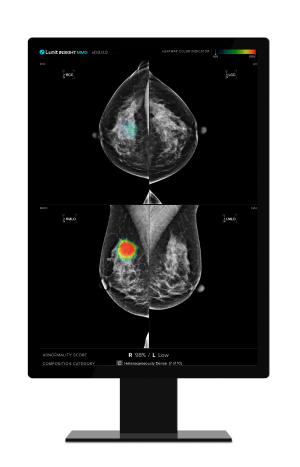
Lunit (KRX:328130.KQ), a leading provider of AI-powered solutions for cancer diagnostics and therapeutics, today announced that in a study recently published in European Radiology, Lunit’s AI-powered mammography analysis solution, Lunit INSIGHT MMG, has been validated for its effectiveness in standalone breast cancer detection. The study, led by Dr. Johanne Kühl and Dr. Mohammad Talal Elhakim at the University of Southern Denmark, compared the AI system’s performance to that of first-reading breast radiologists across an entire screening population.
The research encompassed mammography screenings performed between August 4, 2014, and August 15, 2018, in the Region of Southern Denmark. It involved 249,402 screenings (149,495 women), and a total of 2,033 breast cancers. Screenings were assessed as normal or abnormal by breast radiologists through double-reading with arbitration.
Questions around this news
What did the Danish study find about Lunit INSIGHT MMG and radiologists?
The study compared the AI system with first-reading breast radiologists across a population screening program in Southern Denmark. At a cut-off chosen to match readers’ average specificity, the researchers found no statistically significant difference in overall accuracy. The release also reports that results differed when the cut-off was set to match readers’ average sensitivity.
What does standalone breast cancer detection mean?
In this context, standalone detection means assessing whether an AI system can identify potential breast cancers from mammograms without relying on a radiologist’s reading as part of that detection decision. It describes how the system is evaluated or used; it does not by itself establish that the system should replace clinical judgment or be used without appropriate oversight.
What is double-reading in mammography screening?
Double-reading is a screening approach in which two readers independently review the same mammogram. If their assessments differ, an additional review or another agreed process may be used to resolve the disagreement. The release describes the Danish screenings as being assessed by breast radiologists using double-reading with arbitration.
The study's key findings revealed that when Lunit INSIGHT MMG’s cut-off score was matched at the first reader mean specificity (capacity of correctly identifying cancer-free exams), it exhibited no statistically significant difference in overall accuracy compared to that of radiologists. However, when the AI threshold was matched at the first reader mean sensitivity (capacity of correctly diagnosing cancer), it showed lower specificity (97.5% vs. 97.7%) and positive predictive value (17.5% vs. 18.7%) and a higher recall rate (3.0% vs. 2.8%) than first readers.
The study findings suggest that with an appropriate cut-off score, Lunit INSIGHT MMG could feasibly replace first readers in a mammography double-reading setting. The cancers detected by AI but missed by radiologists suggest that integrating AI to support double-reading within screening could lead to an increase in the overall number of detected cancers. Importantly, the clinicopathological characteristics of the detected cancers would not change significantly with the implementation of AI.
"Following our first prospective study in Sweden, where Lunit INSIGHT MMG demonstrated its capability to replace one human reader in Europe's double-reading setting—a role it currently fulfills at the Capio S:t Göran Hospital—we are excited to observe the outcomes of this recently published study, further confirming the effectiveness of Lunit INSIGHT MMG in standalone breast cancer detection," said Brandon Suh, CEO of Lunit. "This research highlights the potential for our AI solution to significantly enhance mammography screenings. It not only offers a promising avenue to improve cancer detection rates but also provides valuable support to radiologists by alleviating their workloads. Ultimately, Lunit INSIGHT MMG has the potential to become an essential tool for both hospitals and patients."
If you detect any issues, problems, or errors in this press release content, kindly contact [email protected] to notify us (it is important to note that this email is the authorized channel for such matters, sending multiple emails to multiple addresses does not necessarily help expedite your request). We will respond and rectify the situation in the next 8 hours.
At a glance
- Company
- Lunit
- Ticker
- KRX: 328130.KQ
- Announcement
- Product
- Location
- Seoul, South Korea
Key figures
- Screenings analyzed
- 249,402
- Women included
- 149,495
- Breast cancers included
- 2,033
- Specificity at sensitivity-matched threshold, AI vs. first readers
- 97.5% vs. 97.7%
- Positive predictive value at sensitivity-matched threshold, AI vs. first readers
- 17.5% vs. 18.7%
- Recall rate at sensitivity-matched threshold, AI vs. first readers
- 3.0% vs. 2.8%
People
- Johanne KühlStudy lead; University of Southern Denmark
- Mohammad Talal ElhakimStudy lead; University of Southern Denmark
- Brandon SuhCEO of Lunit
