




The DRC government has effectively established long-term control over ~75% of the global cobalt trade flow.
September 29, 2025 -- The Democratic Republic of Congo (DRC) announced on 20 September that it will lift its suspension on cobalt exports, effective 16 October, replacing it with a quota system to remain in effect until at least 2027.
According to the announcement from ARECOMS, the country’s regulatory and control authority for strategic mineral markets, a maximum volume of 96,600 tonnes of cobalt will be authorised for export. Of this, 9,600t will be earmarked as a “strategic quota” allocated to ARECOMS, which will have sole discretion over its distribution.
The quota allocation will be “calculated on a pro rata basis using historical export volumes.” We interpret this to mean that each company’s export market share will be assessed from a specific reference period and allocated accordingly. This approach may also leave room for companies to negotiate their share.
Importantly. ARECOMS added that quotas could be revised in the case of a “significant imbalance in the cobalt market.”
It also warned that it can withdraw the initial quota allocated to any company that fails to comply with applicable laws and regulations. In addition, ARECOMS “reserves the right to organise the purchase of cobalt stocks that exceed any company’s quarterly quota allocation.”
At a glance
- Announcement
- Regulatory
- Location
- Democratic Republic of Congo
Key figures
- Maximum authorised cobalt export volume
- 96,600 tonnes
- Strategic quota allocated to ARECOMS
- 9,600t
- Quota framework duration
- until at least 2027
- Monthly export availability cited in the release
- 7,250 tonnes a month
- Average monthly Chinese cobalt imports in the cited period
- 16.2kt per month
- Estimated period of tight market conditions
- 4–6 months
Products and programs
Putting the quota into context: This new system will equal just 7,250 tonnes a month available for export. In the 17 months before the impact of the export ban. China’s cobalt imports averaged 16.2kt per month.
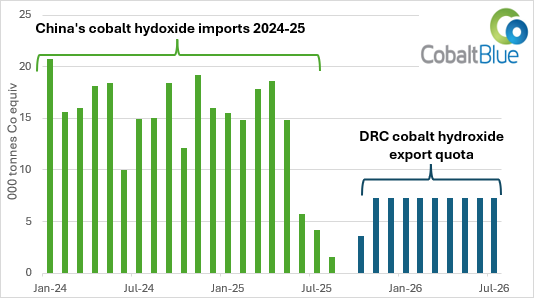
What happens next? After more than 7 months of the export ban, refinery inventories have reached critical levels. Even though exports will resume in October, the earliest shipments will reach China by January, keeping the cobalt market tight and highly competitive for the next 4–6 months and creating strong upside pressure on prices.
What are the longer-term implications? If quotas are strictly enforced, refiners will be competing for less than half of normal availability. This would push the global cobalt balance from surplus to deficit in 2026, with the potential for a sharp price response.
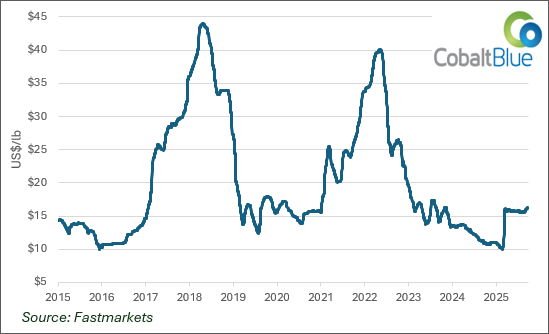
However, the new framework gives ARECOMS considerable flexibility. The regulator can adjust quota volumes and purchase cobalt stocks exceeding a company’s allocation, effectively controlling how much material reaches the market. These levers provide powerful influence over price direction and may be used to prevent a prolonged return to +$35/lb levels, which risk triggering demand destruction in the battery sector.
While this marks the early stage of a structural shift in cobalt market dynamics, the DRC has clearly positioned itself to manage both producer and consumer inventories – and by extension, price stability. The “sweet spot” for pricing will be one that maximises government revenue without undermining demand, likely anchored around the long-term real average of ~$26/lb.
If you detect any issues, problems, or errors in this press release content, kindly contact [email protected] to notify us (it is important to note that this email is the authorized channel for such matters, sending multiple emails to multiple addresses does not necessarily help expedite your request). We will respond and rectify the situation in the next 8 hours.
In brief
The Democratic Republic of Congo plans to resume cobalt exports on October 16, replacing its suspension with a quota framework that is expected to remain in place until at least 2027. The release says ARECOMS will authorise up to 96,600 tonnes for export, including a strategic allocation under the regulator’s control. Company allocations are to reflect historical export volumes, and quotas may be changed if the cobalt market becomes significantly imbalanced. The release argues that shipments will take time to reach China and that limited availability could keep the market tight in the near term. It also says the system could give the DRC substantial influence over supply and prices, while noting that the regulator can revise allocations or purchase excess stocks.
Key takeaways
- The DRC plans to lift its cobalt export suspension on October 16 and introduce quotas through at least 2027.
- ARECOMS will authorise a maximum export volume of 96,600 tonnes, including a 9,600-tonne strategic quota.
- Company allocations are based on historical export volumes and may be adjusted under specified market or compliance conditions.
- The release says export timing and quotas could constrain supply and influence cobalt market conditions.
