




Kuala Lumpur, May 20, 2025 -- Malaysia’s efforts to tackle food waste are gaining fresh momentum through a bio-based Food Waste Composting initiative under the Kembara Komuniti Programme by the Malaysian Bioeconomy Development Corporation (Bioeconomy Corporation).
In brief
Malaysia’s Bioeconomy Development Corporation is working with MAEKO Sdn Bhd on a community food-waste composting initiative in Kuala Lumpur. Under the Kembara Komuniti Programme, three MunchBot machines have been provided to two farming communities, involving 45 participants. The company says the machines can convert food waste into compost in 24 hours, and participants will receive training over 12 months. Bioeconomy Corporation says compost and agricultural produce sales could provide participants with additional income of up to RM450 a month. The programme is intended to support local composting skills, reduce food waste and lessen reliance on chemical fertilisers. Community representatives described the initiative as an opportunity for residents to gain practical experience and build household food-waste management habits.
Key takeaways
- The initiative involves two Kuala Lumpur farming communities and 45 participants.
- Three MunchBot composting machines, each with a five-kilogram capacity, were supplied.
- Participants will receive training over 12 months in sustainable food-waste management.
- Bioeconomy Corporation says participants could earn up to RM450 monthly from compost and produce sales.
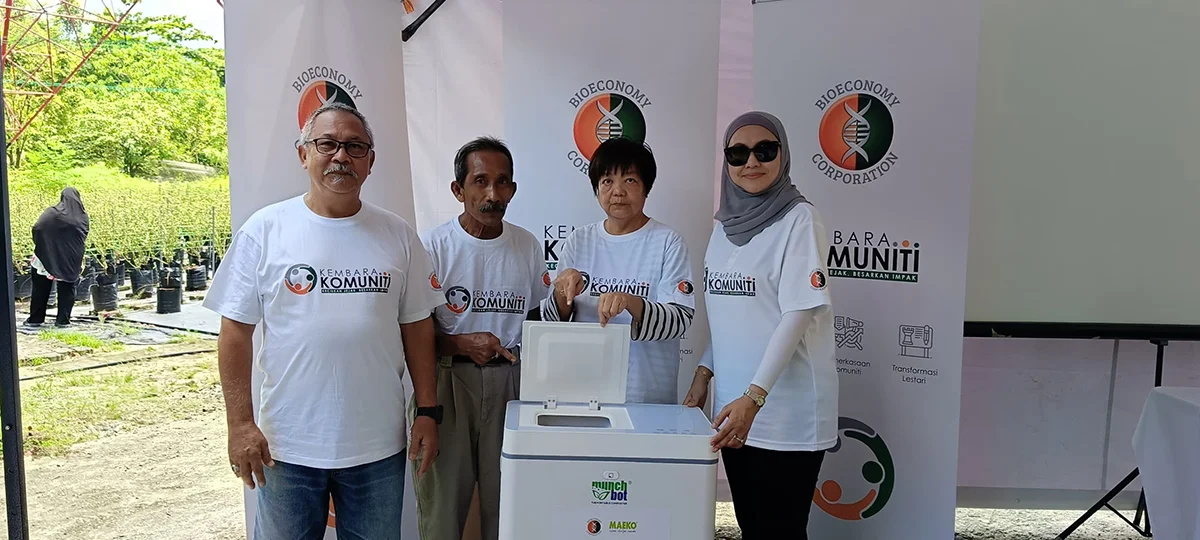
This initiative promotes environmental sustainability through a closed-loop circular economy model, carried out in strategic collaboration between Bioeconomy Corporation and MAEKO Sdn Bhd (MAEKO), a company under the Bio-based Accelerator programme and food waste management expert.
Senior Vice President of Industry Support at Bioeconomy Corporation, Nora Mohamed, said the programme involves 45 participants from two local farming communities – Kebun Agro Harmoni Community of the Seri Sabah Public Housing Residents’ Association and Kebun Agro Desa Rejang Community here today.
She explained that three MunchBot composting machines, each with a five-kilogram capacity, have been supplied to these communities. In addition, participants receive comprehensive training over 12 months on sustainable food waste management practices.
“Community members can recycle their food waste and turn it into bio-based compost in just 24 hours – a dramatic improvement compared to conventional methods, which can take 60 days or more.
“For every 450 kilograms of food waste processed, up to 90 kilograms of high-quality compost can be produced,” she said during a training and briefing session held today at Kebun Agro Harmoni in Seri Sabah here today.
Also present were the Chairman of the Kebun Agro Harmoni Community of the Seri Sabah Public Housing Residents’ Association, Raja Rahim Raja Muhaiddin, and the Chairman of the Kebun Agro Desa Rejang Community, Mohd Noor Md Tahir.
Nora added that what’s even more encouraging is that participants can earn extra income by selling the compost and their agricultural produce.
“With effective management, participants have the potential to earn up to RM450 a month through this sustainable initiative,” she said.
She emphasized that the Kembara Komuniti – Food Waste Composting programme positions Bioeconomy Corporation as the primary driver for technology transfer related to composting.
Meanwhile, MAEKO – a participant in the Bio-Based Accelerator Programme with expertise in composting technology and food waste management – acts as the programme facilitator.
According to Nora, this initiative directly contributes to reducing food waste, lowers dependency on chemical fertilisers, and promotes the growth of fresh, safe, and chemical-residue-free produce.
“It also helps enrich soil fertility and ensures the sustainability of local food sources,” she said.
Additionally, Nora encouraged manual composting at home as a daily practice to raise awareness and promote active community involvement in environmental care.
She stated that the initiative by Bioeconomy Corporation – an agency under the Ministry of Science, Technology and Innovation (MOSTI) – aligns with the National Biotechnology Policy 2.0 and the Ministry’s aspirations to empower science-based technologies, expand community adoption of technology, and foster innovation through sustainable entrepreneurship.
Meanwhile, Raja Rahim noted that the programme offers direct benefits to local residents, particularly by improving their quality of life.
“Residents have responded positively to the programme, gaining hands-on experience in producing their own bio-based compost and cultivating healthier, fresher crops,” he said.
Mohd Noor expressed hope that the year-long programme would help instil greater awareness of household food waste management among the local community.
“Our goal is to turn food waste composting into a daily habit that benefits everyone in the neighborhood,” he said.
-END-
If you detect any issues, problems, or errors in this press release content, kindly contact [email protected] to notify us (it is important to note that this email is the authorized channel for such matters, sending multiple emails to multiple addresses does not necessarily help expedite your request). We will respond and rectify the situation in the next 8 hours.
At a glance
- Company
- Malaysian Bioeconomy Development Corporation (Bioeconomy Corporation)
- Location
- Kuala Lumpur, Malaysia
Key figures
- Participants
- 45
- Composting machines supplied
- three
- Capacity of each machine
- five-kilogram
- Training period
- 12 months
- Composting time
- 24 hours
- Potential monthly income
- up to RM450 a month
People
- Nora MohamedSenior Vice President of Industry Support at Bioeconomy Corporation
- Raja Rahim Raja MuhaiddinChairman of the Kebun Agro Harmoni Community of the Seri Sabah Public Housing Residents’ Association
- Mohd Noor Md TahirChairman of the Kebun Agro Desa Rejang Community
Products and programs
Earlier from Malaysian Bioeconomy Development Corporation (Bioeconomy Corporation)
- Malaysia, Japan Seal RM1.34 Billion in Green Bioeconomy Deals at EXPO 2025 Osaka
- Kasih BIO Programme Evokes Passion in STEM Among Students, Supports Orang Asli Community & Asnaf Students
- 38 BNP Labs: Driving Innovative Commercialisation, Empowering Malaysian Bio-Entrepreneurs July 17, 2024
- NBiOSHOWCASE 2024 to Attract RM1.32 Billion In New Investments, 500 Job Opportunities In Biotechnology Industry
