


APAC vs US Press Releases: What 1,000 Announcements Reveal
August 27, 2026 at 05:01 AM UTC
 Written by Yi Yun
Press releases follow a familiar structure in almost every market. There is a headline, an announcement, supporting details, a quotation and information about the organization.
That can make distribution look universal. Write one release, select a region and send it over the wire.
A PR firm serving a company that is new to APAC or the US faces a more difficult question. What does the client consider newsworthy? How much background does the market expect? Is a partnership important enough to announce? Can a feature-style brand story stand on its own, or does the release need a report, event, deadline or product development at its center?
The surrounding feed also matters. A company is not publishing into an empty channel. Its release appears beside the announcements, legal notices, research, launches and corporate updates already moving through that distribution environment.
We wanted to see how different those environments actually were.
We classified 500 recent announcements distributed through our APAC network and 500 releases from a large US-based newswire. We used the same 20 categories for both samples, then compared what organizations chose to send.
The results do not measure which release format receives the most clicks or media coverage. They show what clients and communications teams in each feed treat as suitable for distribution. For an agency advising a company across regions, that is a useful starting point.
The first difference would change how any PR team interprets the US feed.
Nearly one in four releases in the US sample was not a product launch, an earnings announcement or an executive appointment. It was a legal notice aimed at investors.
Securities class action solicitations accounted for 23.8% of the 500 classified releases published on a large US-based newswire. These included shareholder alerts, filing-deadline reminders and notices from law firms investigating the officers or directors of a named company.
Among 500 recent APAC announcements distributed through our network, the same category accounted for 0.0%.
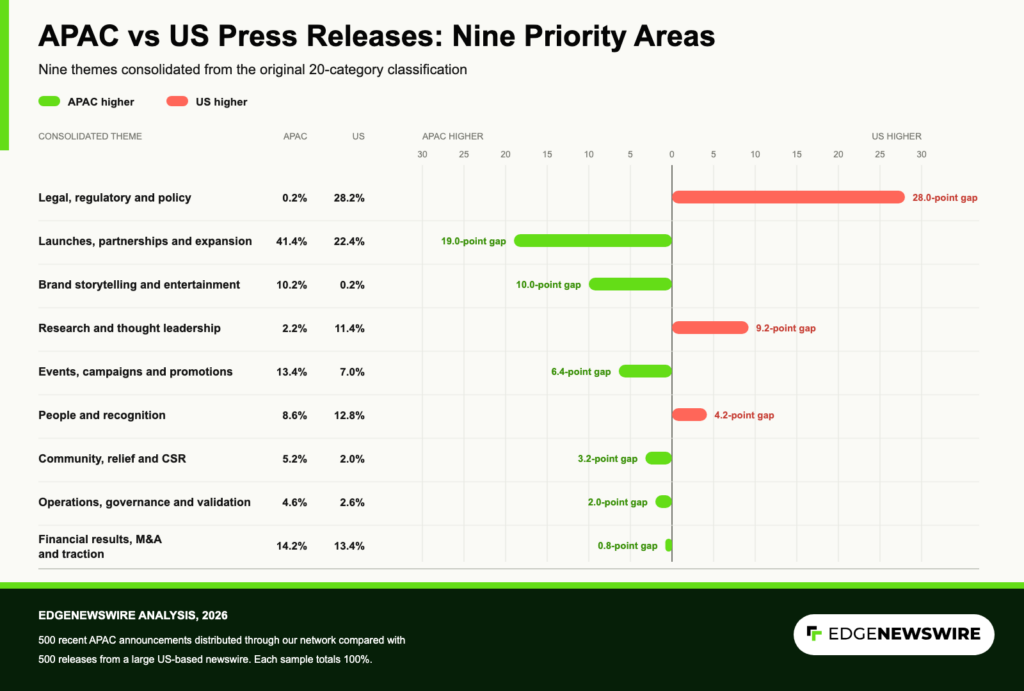
That was the largest difference in the study, but it was not the only one. The APAC feed carried substantially more partnerships, expansion announcements, events and feature-style brand stories. The US feed carried more research, commentary, appointments and investor litigation notices.
The press release may be a global format, but organizations do not use it in the same way everywhere. A campaign that feels natural to an APAC client may need a stronger event or finding for US distribution. A US release entering APAC may need more context about relationships, regional significance and market intent.
How the comparison worked
We classified the latest 500 announcements distributed through our APAC network and the latest 500 releases collected from a large US-based newswire. Our APAC sample covered 30 March to 23 August 2026, while the higher-volume US feed covered August 2026. We assigned every title one primary category using the same 20-category framework.
The comparison describes these two release streams. It provides a practical view of what a reader, journalist or communications team encounters in each feed.
At the original 20-category level, these were the five largest differences:
| Category | APAC sample | US sample | Higher in | Difference |
|---|---|---|---|---|
| Securities litigation solicitation | 0.0% | 23.8% | US | 23.8 pp |
| Brand storytelling without an announcement | 9.6% | 0.2% | APAC | 9.4 pp |
| Research and thought leadership | 2.2% | 11.4% | US | 9.2 pp |
| Partnership | 11.0% | 3.2% | APAC | 7.8 pp |
| Expansion and investment | 11.2% | 4.6% | APAC | 6.6 pp |
To make the broader pattern easier to compare, the chart below consolidates all 20 categories into nine non-overlapping themes.
The APAC feed is built around market activity
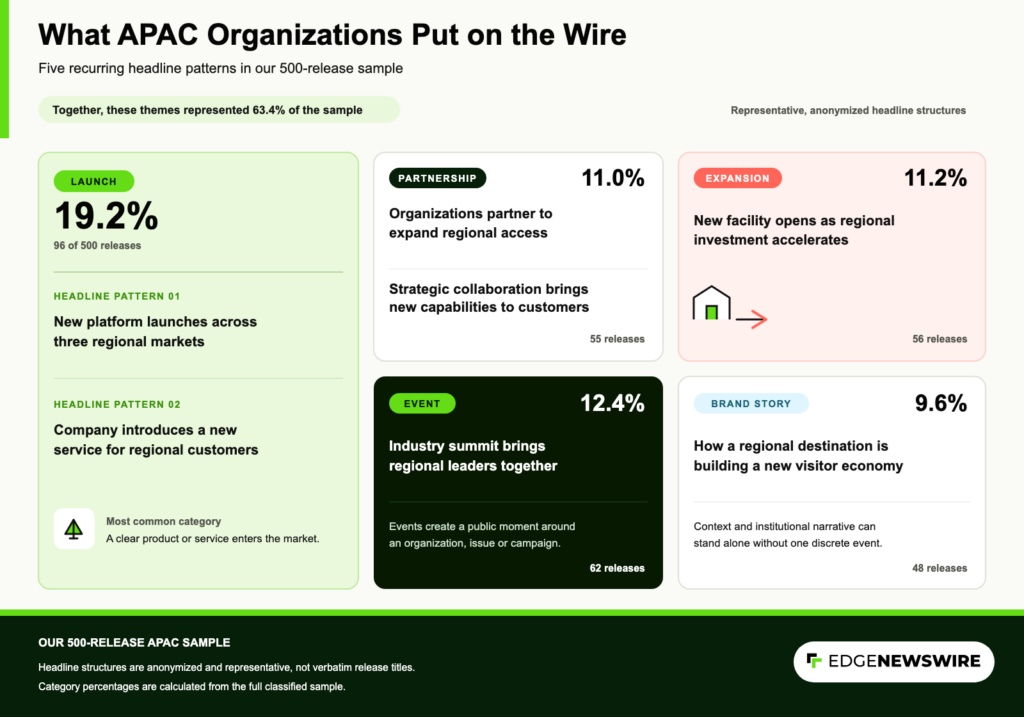
Product and service launches were the largest category in the APAC sample, representing 19.2% of releases.
Events and campaigns followed at 12.4%. Expansion and investment accounted for 11.2%, while partnerships represented another 11.0%.
Together, those four categories made up 53.8% of the APAC feed. More than half of the titles therefore centered on bringing something to market, entering a market, building a relationship or creating a public moment around an organization.
That mix gives the APAC feed a forward-looking character. Companies use the wire to show movement: a new offering, a new territory, a new collaborator, a new facility or an event intended to attract attention beyond the organization itself.
Partnership and expansion releases are especially revealing. Combined, they represented 22.2% of the APAC sample, compared with 7.8% of the US sample. The difference is not simply that APAC companies had more corporate activity during the period. It shows how frequently collaboration and regional growth were considered worthy of a formal distributed announcement.
Our APAC sample also contained a category that was almost absent from the US feed: brand storytelling without a discrete announcement.
These feature-style releases described a destination, organization or broader trend without placing one specific event at the center. Titles included pieces about rural tourism, museums as cultural bridges and regional destination strategies. They read more like sponsored features or institutional narratives than conventional announcements.
There were 48 such releases in the APAC sample, or 9.6%. The US sample contained one, representing 0.2%.
This does not make one approach more legitimate than the other. It shows a difference in what the wire is expected to carry. Within the APAC feed, distribution is used not only to record an event but also to build context, shape perception and introduce a place or brand to audiences that may not already know it.
For a PR firm onboarding an APAC client, this pattern helps explain the client’s instincts. The client may see a new partnership, market expansion, event or institutional story as evidence of momentum. The agency does not need to remove that context. It needs to identify the clearest consequence for the reader and make the central development unmistakable.
The US feed is more procedural and event-specific
The US sample looked different from the first screen of results.
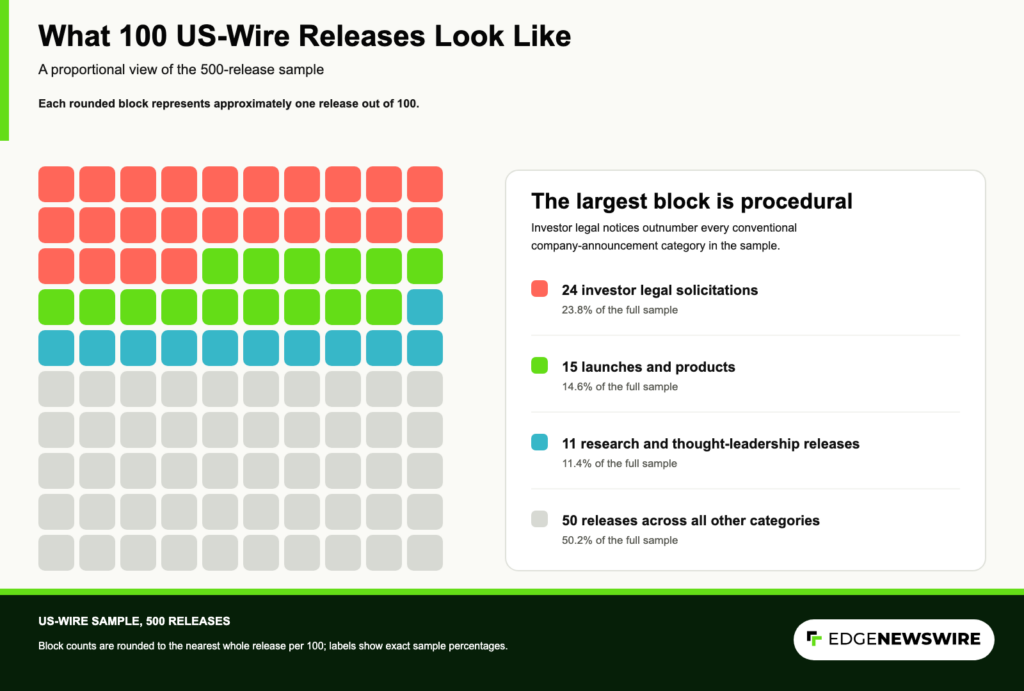
Securities litigation solicitations were its largest category at 23.8%. The concentration was not caused by one isolated case. The feed contained repeated notices from law firms announcing investigations, reminding investors of filing deadlines and seeking shareholders affected by alleged corporate misconduct.
These releases serve a clear function. They put a dated legal notice into a widely distributed public channel. They also change the composition of the feed. Anyone monitoring raw US-wire volume encounters a substantial layer of content that is neither company news nor independent financial reporting.
Research and thought leadership formed another 11.4% of the US sample, compared with 2.2% in APAC. This category included market-sizing reports, consumer surveys, expert commentary and syndicated advice content.
Unlike APAC’s feature-style brand stories, these pieces were usually anchored to a stated finding, report or expert position. They gave the release a discrete reason to exist even when no product or corporate transaction had occurred.
The US feed also carried more appointments and awards. Those are familiar corporate communications categories: a named person enters a role, or a named organization receives a specific recognition. The common thread is a defined event with an identifiable party and a clear date.
Launches still mattered. They represented 14.6% of the US sample and were the largest conventional company-announcement category. The difference was the surrounding material. A US release competed for attention beside legal deadlines, research findings, appointments, awards and other tightly defined events.
For an APAC company entering the US, this feed creates a practical test. The release should answer “What happened?” quickly. A broad company story may become stronger when it is anchored to a launch date, research finding, investment, appointment, measurable result or other development that gives the headline a clear reason to exist now.
Two communication cultures emerge
The APAC feed often uses a release to establish context and momentum through relationships, expansion, events and institutional stories. The US feed uses it more frequently as procedural infrastructure for a deadline, finding, appointment, recognition or other defined development.
Legal systems, issuer mix and platform practices contribute to the difference, but the practical result is clear. A release enters two different sets of expectations depending on where it is distributed.
Where the two feeds meet
The feeds were not different in every category.
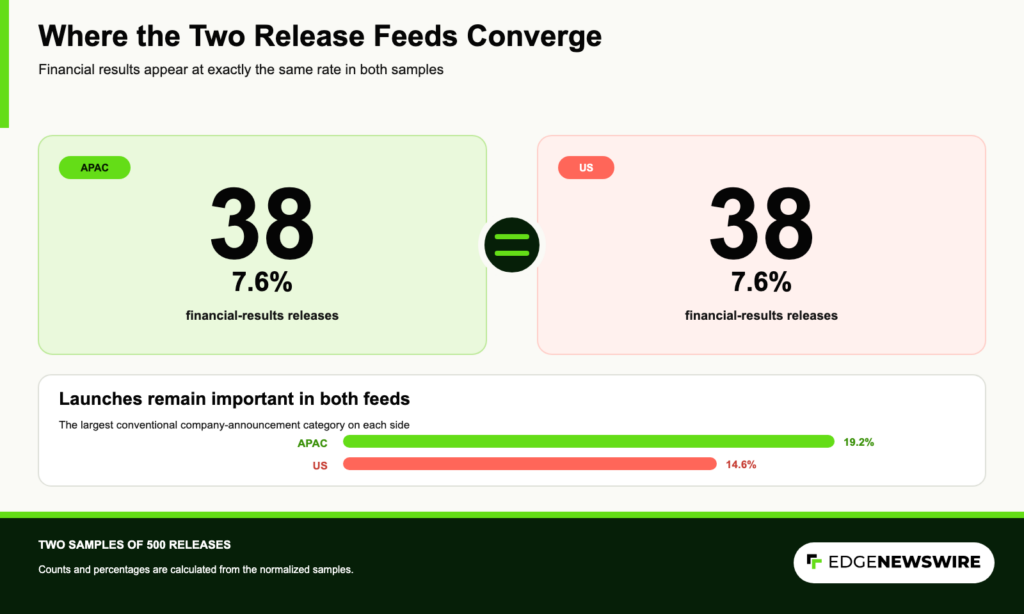
Results and financial announcements accounted for 38 releases in each sample, representing 7.6% on both sides.
That symmetry matters. Earnings and financial results are among the most standardized forms of corporate communication. They have a defined period, expected metrics, named reporting entity and clear reason for publication. The same basic function transfers readily between distribution environments.
Launches were also important in both samples. They were the largest conventional company-announcement category on each side, at 19.2% in APAC and 14.6% in the US feed.
Organizations everywhere use the wire to introduce something new and document financial performance. The larger differences appear in what each ecosystem accepts around that shared core.
What PR firms should take home
The data shows what organizations send, not which format earns the most attention. Its value is in helping an agency anticipate the communication environment a new release will enter.
1. Understand the client’s native idea of news
An APAC company may arrive with a partnership, expansion plan, event or broader brand narrative. Those are common instincts in our sample, where partnerships and expansion represented 22.2% of releases. Identify what the client is trying to prove, then decide which detail deserves the headline.
2. Give an APAC story a sharper US news peg
The US feed contained very little brand storytelling without an announcement. Only 0.2% of releases fell into that category, compared with 9.6% in APAC.
An APAC company entering the US should avoid relying on atmosphere or background alone. Connect the story to a launch, new data, an appointment, an investment, a customer milestone or another dated development. Keep the regional context, but make what changed immediately clear.
3. Give a US story enough APAC context
A US company entering APAC can make the opposite mistake. The release may state the event clearly while assuming the audience understands why the organization, partner or product matters locally. Explain the relationship, markets involved, local problem and commitment behind the announcement without adding empty corporate language.
4. Benchmark against the right category
Raw volume is not a neutral measure. Legal solicitations account for nearly a quarter of the US sample, while the APAC feed includes more feature-style stories. Compare launches with launches, research with research and financial results with financial results. Otherwise, overall volume can obscure the client’s real competitive visibility.
5. Adapt the framing without changing the facts
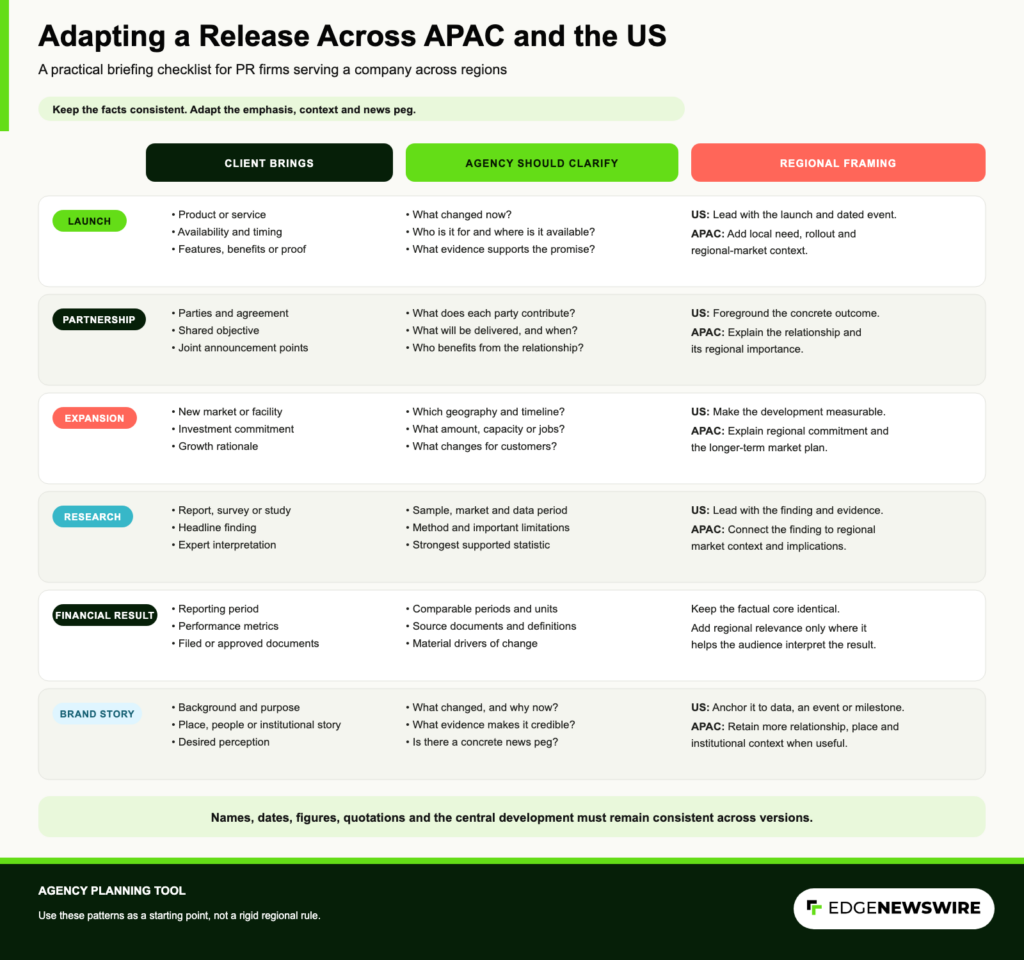
A wire is not just a pipe
Press releases are often discussed as though distribution networks were interchangeable pipes carrying the same kind of material to different places.
The latest releases in these two feeds suggest otherwise. The surrounding communication culture affects what clients consider news, what a release competes against and how an agency should frame the story.
Our APAC sample was dominated by launches, events, expansion and partnerships, with a meaningful layer of brand storytelling. The US sample devoted nearly one-quarter of its flow to investor legal solicitations and about five times the share to research and thought leadership.
Yet both samples contained 38 financial-results releases, and launches remained central on each side.
The format travels. The communication culture around it changes.
